

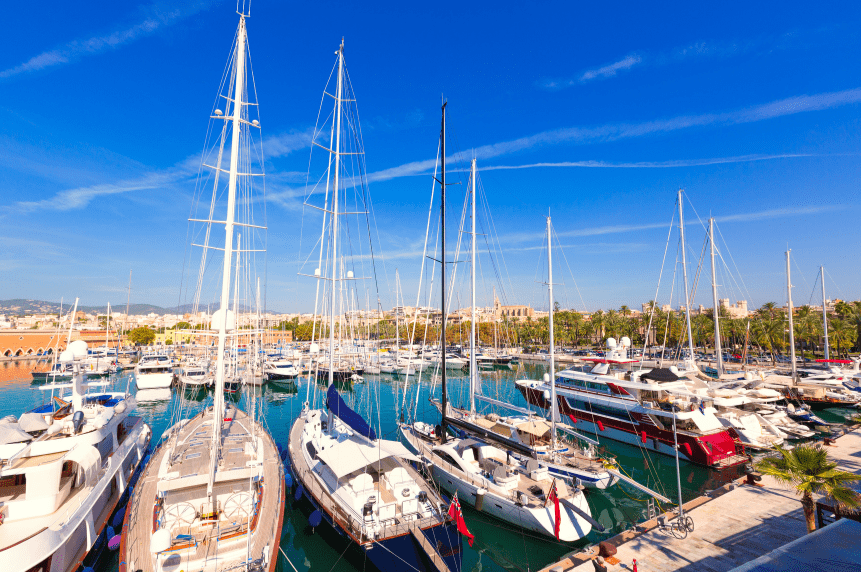
Berthing a motor yacht during your jaunt around the Balearic Islands might seem easy enough. After all, surely mooring in Mallorca is just like backing your car into a parking space? Anyone who’s ever tried to back into a tight marina berth on a windy afternoon will tell you otherwise. With summer demand across the Mediterranean putting space at a premium, even in the more than 50 marinas and harbors set across Mallorca alone, berthing a motor yacht can be challenging. In this guide, we discuss some of the biggest challenges of mooring your yacht and some of the different ways you can do it.

Different Types of Mooring
The cost of mooring in Mallorca can be eye-watering, with some berths going for hundreds of Euros a night in busy ports during the season. Already, a simple mistake or misjudgement isn’t just a safety risk but a potentially expensive error.
In the Mediterranean, you’ll encounter two types of mooring, known as Med mooring, or stern-to-moon mooring, and groundline mooring. Let’s go through each of these options for a better understanding of your options.
Med Mooring
When you approach a berth in a marina throughout the Mediterranean, you won’t be sliding alongside a pontoon. Instead, it works like this:
1. Reverse stern-to towards the pontoon or quay.
2. Secure your stern lines to the fuck.
3. Hold your bow off using an anchor or a groundline.
Groundline Mooring
Your other option is groundline mooring. If this is provided in your port of choice, you won’t need your anchor:
1. There will be a pick-up line along the seabed, known as a slime line. This is attached to the quay on one end and has a heavier groundline running parallel to the dock.
2. After securing your stern, you pick up the pick-up line from the quay using a boathook. Walk it forward to the bow, cleating and tensioning as you go.
3. You may need to use either one or two lines per berth. These will either be along the centreline of the bow or positioned to port or starboard.
Why would you use groundline mooring over Med mooring? Under this system, it’s possible for marinas to pack in more boats. This is why it’s steadily becoming more prominent, as it enables marinas to become more profitable in the season by increasing their available capacities.
Common Issues When Berthing a Motor Yacht
Skippers face several challenges when berthing a motor yacht. Getting any part of the process wrong can quickly result in damage to your boat and neighbouring boats. Before heading out on your Mediterranean voyage, being aware of the challenges allows you to plan to overcome them.
So, what are the biggest problems encountered when trying to berth your yacht?
1. Crosswinds and Prop Walks
Berthing stern-to means you’re already risking your boat shifting at the worst possible moment. Throw in a prop walk, which is the sideways pull of your propeller, and you’re looking at a scenario where your stern moves one way and the bow blows the other, thus pushing you off your line.
Motor yachts tend to have more windage and their higher topsides, so if you’re approaching slowly, you tend to see more of an impact from the wind.
2. Loose Lines in the Water
Mooring using the groundline system is convenient, but it raises the hazard of loose lines in the water. This can lead to issues like:
· Pick-up lines across your stern gear.
· Prop fouling whilst leaving your mooring.
· Lines tangling under the hull.
Untangling these lines can be extremely problematic, resulting in either hiring a professional diver to manage the problem or doing it yourself. It can also result in mechanical damage to your vessel.
3. Getting the Distance Right
If you’re Med mooring with your motor yacht, the classic challenge is getting your distances just right. Get too close and your boat hits the quay as it surges with the water. Stay too far away and your gangway won’t reach the quay.
In the case of mooring under the groundline method, you’re still facing a similar problem. Getting the distance right here means balancing the length and tension of the stern lines and the tension on the bow groundline.
Boats that boast swimming ladders and big bathing platforms are especially problematic, as a single misjudgement can lead to a hefty repair bill.
4. The Sardine Tin Berth
Mooring in Mallorca during the season raises the issue of berths being extremely narrow, thus allowing boats to be packed together. Although it increases capacity, it also reduces the margin for error.
The same issues occur every year, including:
· Swing Room – Slight sideways drift can leave your vessel on your neighbour’s anchor or top sides.
· Hard Contact – Failing to rig up enough fenders or not putting in the necessary protocols to stop them from rising up can put your hardpoints into direct contact with your neighbour’s.
· Spectator Pressure – Inexperienced skippers can often find themselves managing berthing with an audience of crews, agents, and charter guests. This extra pressure often results in mistakes, especially in major Mediterranean ports.
5. Depth and Drive Clearance
Berthing stern-to with a motor yacht requires you to calculate the depth of the quay and the depth of the groundlines.
It’s not uncommon for older quaysides to shoal up close to the edges, leaving your rudders and stern drives at risk. Furthermore, if the groundlines rise toward the bow, boats with bulbous bows or deep-V hulls could press them inward, leading to chafe.
Generally, popular marinas are well-dredged and managed, but every berth will have a maximum length and draft limit. Familiarise yourself with both before attempting to moor in any marina.
6. Communication Breakdowns
Coordination is everything when mooring, especially if you’re working with a larger vessel. You might have someone at the helm, crew members handling stern lines, another crew member walking along the bow with the pick-up line, or someone shouting instructions from the quay.
Add in the fact that a noisy engine could be impacting your ability to communicate. Without a hand-signal system you all understand, you’re risking a mistiming and a potential disaster.
How to Avoid Mooring Problems in the Mediterranean
Lack of experience frequently causes problems, but the best way to learn is by doing. That’s why it’s essential to prepare for mooring long before you reach the dock.
With that in mind, follow these tips for preventing mooring issues on your next trip:
· Pre-Rig Everything – Ensure everything has been rigged before you enter the marina, including gloves, boathooks, and stern lines. Brief your crew to ensure everyone is in position and knows how to use hand signals to keep in contact.
· Manage the Metrics – Maintaining control means factoring in wind speeds, boat speeds, and your prop walk in advance. Approach slowly while adjusting to the conditions, rather than sticking to a rigid pathway.
· Back Away – If something unexpected happens during your approach, it’s always best to back away and opt for a second attempt. This could save you from a costly repair bill.
· Proper Groundline Handling – If you’re using groundlines, keep the engine in neutral while the line is close to the stern. After attaching the stern lines, walk the groundline outside the pulpit and all rails, before securing it to the bow cleat. Tension and ensure the boat is at a safe distance from the quay.
· Protect Your Boat – Use fender boards to protect your boat and your neighbour’s. Don’t be afraid to use extra if you’re being squeezed between a couple of bigger boats.
Final Thoughts
Mooring is one of the most vital skills any yachtsperson can have. It’s also where beginners most commonly experience accidents, as it is part art and part science. Take a certified training course to help prepare you for mooring this coming season.
If you’re lacking in confidence, another alternative is chartering a yacht instead. Yacht charters mean you don’t have to worry about any of the operational aspects, including mooring. With an experienced crew by your side, your only obligation is to enjoy your trip stress-free.
Berthing a Motor Yacht FAQs
How much does it cost to moor a motor yacht in Mallorca?
The cost of mooring in Mallorca depends entirely on the length of your trip, the season, and where you’ll be coming into port. Typical leisure yachts could range from a few Euros to a few hundred Euros a night.
Generally, small, municipal ports are your cheapest option instead of high-end private marinas. However, beware that berths in the former tend to fill up quickly.
How does groundline mooring differ from using an anchor?
Mooring with a groundline means using a chain or permanent line fixed to the seabed. You’ll pick it up via a pick-up line on the quay and then lead it to your bow. Rather than dropping an anchor, you’re using the tension of this line to hold your bow away from the quay. It’s considered far more space-efficient than using an anchor.
Do I need to reserve a berth in advance?
Not necessarily. In the off-season, it’s possible to turn up without a reservation, but in the high season, demand is intense, which can make it difficult to find an appropriate berth that matches your specs.