

Mooring a yacht is among the biggest challenges, even for experienced skippers. Try to berth a motor yacht when the waters are a bit choppy, or there’s a lot of wind around, and it’s enough to have you sweating. The yacht joystick was brought in to ensure you can moor your boat from a single, intuitive interface.
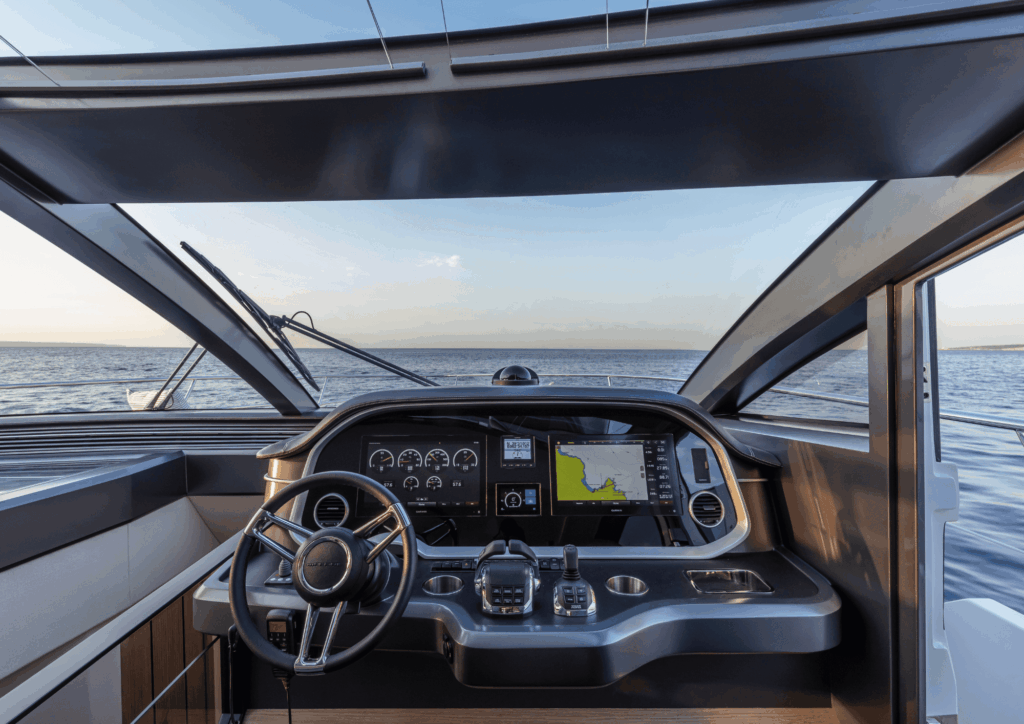
Table of contents
New yachts for sale today often have more advanced joystick systems than ever before, making them far more than a docking aid. They blend throttle, steering, and gear control into one hand. But that doesn’t mean everyone is onboard with these systems. In this guide, we go through what they are and the pros and cons of having one on board.
What is Yacht Joystick Control?
Yacht joystick control systems are effectively an integrated helm interface. Every little hand movement is coordinated across your steering and propulsion, giving you more control over where your vessel is going.
Some of the functions include:
- Throttle and gear selection.
- Steering angles.
- Thruster activation.
- Position inputs.
- Heading inputs.
The simplest way to think about it is that if you want to move sideways, you push the joystick to the side, and the system handles the hard part of managing thrust and steering to get you to where you need to be at low speeds.
Where Did Boat Joysticks Come From?
Joystick concepts aren’t a new thing. We’ve been experimenting with them for decades, with early options appearing in the early 1990s. For many, the era of the joystick began with the Volvo Penta IPS Joystick in 2006. Even back then, it was framed primarily as a mooring revolution.
At the time, they were nothing more than docking assistants, but they’ve steadily taken on other functions, including station-keeping and joystick driving modes. Luxury yachts now will often have joystick systems that cover a range of other systems, including outboards, sterndrives, and hybrid setups.
How Does Joystick Control Work?
Joystick control is all about integration. It only works because it can command steering and thrust independently with enough precision to force sideways motion at low speeds. Here’s how it works:
· Register Intent – The brain behind the joystick system is Electronic Vessel Control (EVC). Whenever you move the joystick, the EVC interprets the movement into commands.
· Vector Creation – The system then creates vectors through independent thrust and steering.
· Sensor Stabilisation – Add in your heading sensors, GPS, and joystick control can expand its assisted docking behaviours and “hold position” commands. New yachts for sale will often integrate satellites to keep the boat in place.
Another important point is that different boats will behave slightly differently due to the range of propulsion layouts available today.
Why Do People Buy Boat Joysticks?
Everyone knows that docking is the most nerve-wracking part of boating. Add in adverse weather and water conditions, and mooring a yacht can tax even the most experienced captain. And that’s primarily why people use joysticks. They’re especially effective for managing issues like:
· Docking in tight slips.
· Berthing a yacht in tricky weather conditions.
· Single-handed line handling.
· Reducing stress and fatigue.
Of course, none of these aspects make it mandatory. Many owner-operators still prefer to do things manually. Let’s go into some of the upsides and downsides of using a joystick to manage docking and low-speed driving.
The Pros of a Yacht Joystick
Using a joystick to simplify docking with fewer moving parts is the primary reason people buy these joysticks, but it’s not the only reason. Here’s why you might want to add a joystick to your vessel.
Easier Docking
Why docking becomes easier with a joystick is all in the mind. Without a joystick, you’re trying to coordinate thrusts, gears, throttles, and your hands on the wheel. Joysticks eliminate the need to coordinate entirely by effectively taking over the technical part of docking.
Low-Speed Precision
Joystick systems can be used to apply controlled thrust in limited bursts alongside minute steering adjustments. The key to this is that it can do it faster than a human can manually. It’s effectively delivering another level of performance you couldn’t achieve on your own.
Transforming How You Wait
Busy marinas might mean waiting for someone else to berth or leave before you can head to your mooring. Whenever you have to wait to berth a motor yacht, you’ll have to hold your position. In the past, this meant circling, anchoring, or just drifting.
Modern joysticks can keep the boat in place using GPS and satellite signals, compensating for wind and currents.
Lowers the Barrier for Owner-Operators
The larger the boat, the less room for error you have. Owners of luxury yachts often need to hire a professional to manage these unwieldy vessels. One of the quieter industry shifts is how joystick control has brought down the barriers for owner-operators to steer their own boats and reduce their reliance on a professional crew.
The Cons of a Yacht Joystick
Joysticks aren’t something everyone wants on their boat for one reason or another. While they do provide boat owners with more options to deal with the challenge of mooring a yacht, it’s also vital to bear in mind some of the disadvantages of these tools. Here’s why you might want to think twice about joysticks.
Cost and Complexity
Joysticks are considered a premium upgrade, as they’re usually bundled on top of expensive infrastructure, including steering systems, sensors, and propulsion architecture. Even when they’re offered as an option, you’ll usually only see them on higher trim levels. In other words, it can cost thousands to incorporate a joystick system.
Plus, more sensors, software, and networked components create more room for something to go wrong. These extra dependencies provide more avenues for your system to break down, so you’re also adding to your maintenance needs.
As for how much a joystick might cost, it can range from a few hundred pounds for third-party remote joysticks to tens of thousands of pounds on higher-value boats. Take note that this doesn’t account for any future maintenance, so it is a significant investment.
Overconfidence and Misconceptions
Joysticks often make docking too easy. Whilst that might not sound like a problem, it can encourage casualness, especially when it comes to newbies. This can mask your proper boat-handling skills, so if something goes wrong and your joystick isn’t working for whatever reason, you might find yourself in a difficult situation.
It’s also worth mentioning that just because joysticks reduce the workload, you still have to understand what your boat is doing, including when to switch back to conventional controls. Far from being a plug-and-play feature, joysticks require training as well.
Compatibility Headaches
It’s possible to retrofit some boat models with joysticks, but whether it’s practical is another issue entirely. Joysticks rely heavily on the systems they’re connected to, whether that’s the steering actuator, engine, or electric throttles. Sometimes, it simply isn’t possible to retrofit a lot of boats.
Speaking of compatibility, despite doing the same thing, not all joysticks are going to feel the same across every boat, brand, and layout. Even if you’ve already used a joystick, buying a new boat often means starting all over again.
Conclusion: Is it Worth Installing a Joystick on Your Yacht?
Weighing up the pros and cons, you might be unsure whether this is really the saving grace you need. Beyond personal preferences, it’s best to opt for a joystick if you’re regularly in marinas or you’re docking short-handed. It’s a fact that this is one technological upgrade that can deliver genuine quality of life improvements.
However, the most important aspect to remember is that it’s not a magic wand. It still needs compatible hardware, regular maintenance, and the right mindset to avoid assuming that it’s some type of fully automated aid.
With all that in mind, is this the right upgrade for you?
Yacht Joystick FAQs
Does adding joystick control increase your yacht’s resale value?
Often, a joystick will increase the value of your yacht when you come to sell it later. Crucially, it increases the number of potential buyers, but this uplift will depend on what market segment you’re aiming at. Primarily, this is an aide that’s most attractive to owner-operators, rather than fully crewed operations.
Do boat insurers require professional training?
Insurers are less concerned about specific components you might have installed. Instead, they’re more focused on your overall experience, the value of your boat, and your claims history.
Nevertheless, showing that you’ve had formal training can still drive down your premiums because you’ll be seen as a lower risk proposition.
What’s the smartest way to learn how to use a joystick?
Practicing with your joystick is the best way to build confidence. Opt for low-risk environments, such as open water with floating markers. Here, you can learn the basic movements, including rotation, diagonal, and sideways. Later, you can graduate to practicing in quiet docks before learning how to manage more complex conditions.
Depending on where you are, you might also find some value in taking a local course, where a more experienced operator can teach you how to use your joystick.