

Estimated reading time: 8 minutes
Table of contents
Luxury yachting is entering a new era. With environmental awareness growing and marine technology opening up a brave new world, today’s latest eco-friendly yachts are cutting fuel consumption and driving fuel efficiency to greater heights.
Now, as an owner, why should any of this matter to you?
In short, think more time on the water and lower costs without compromising on the luxury, comfort, and performance you expect. With hybrid yachts like the Pearl 100 Hybrid appearing on the high seas, it’s the starting pistol for a new era of yachting. Here’s what you need to know.
What are Eco-Friendly Yachts?
It’s easy to roll your eyes at yet another product with the eco tag slapped across it. As you’d expect, eco-friendly yachts are designed to reduce the impact of yachting on the environment. But these have real benefits for owners, too.
So, what can you expect from eco-friendly yachts? In a few words:
- Improved efficiency
- Reduced fuel consumption
- More longevity
In some jurisdictions, buying into the green yachting revolution might even result in tax breaks, or at least lower charges. After all, traditional diesel-powered yachts consume fuel at an incredible rate, which is the chief reason why the ongoing costs of owning a yacht can be so immense.
By tackling this problem, modern yacht hybrid propulsion technology could herald a more accessible industry. Of course, that doesn’t imply environmentally friendly yachts are emissions-free because that’s simply not true.
The benefits depend largely on the technology, construction, energy sources, and even how it’s sailed.
How Do Hybrid Yachts Work?
Hybrid yachts combine conventional internal combustion engines with electric energy storage and electric motor systems. Depending on the vessel, these rely on different power sources instead of exclusively diesel propulsion.
For example, some yachts will switch to electric motors at lower speeds, with the diesel engine only kicking in when you need the extra power to tackle fast-speed cruising or long-distance cruising. Meanwhile, the electric batteries cover the onboard equipment, meaning you’re not running the generators constantly just to keep the lights on.
More and more yacht owners are becoming especially interested in hybrid propulsion systems because of the flexibility on offer. One of the main benefits is that, in the right conditions, they run much more quietly, which is ideal if you’re trying to enjoy a peaceful time on the water or traversing a quiet marina late at night.
Eco-Friendly Hybrid Yachts Go Beyond Propulsion
Most of the attention on eco-friendly vessels focuses on yacht hybrid propulsion. It’s no surprise because this is where many of the biggest advances are. But it’s only a single aspect of eco-friendly design.
Examples of other innovations include:
- Changing hull shapes to reduce resistance in the water and lower overall energy consumption.
- Improved insulation to retain heat.
- More efficient onboard systems to cut electricity consumption.
The yachting community is also moving toward more responsible maintenance practices, wastewater management, and route planning to further reduce its environmental impact. In European destinations, where more coastal areas are protected than ever, this is becoming increasingly important.
The Pearl 100 Hybrid: A New Direction for Luxury Yachting
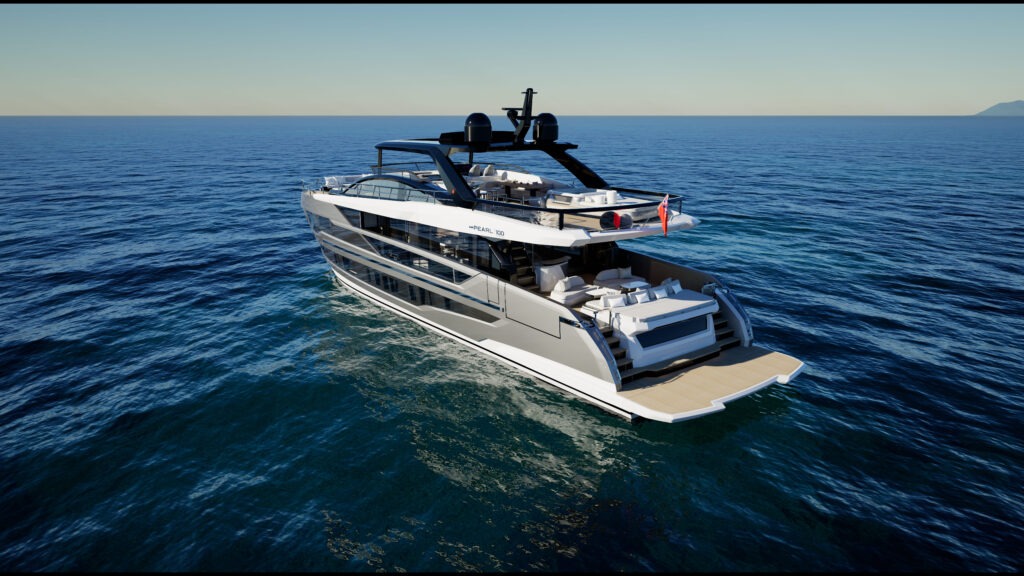
The Pearl 100 Hybrid is one of the standouts in luxury yachting, straight from the British manufacturer Pearl Yachts.
At 96 feet, or 30 metres, this is the largest vessel ever produced by Pearl and the very first to incorporate hybrid propulsion. The 2025 model completed its sea trials in 2026, combining advanced engineering with state-of-the-art design and luxury.
Despite its obvious attraction in terms of interior and exterior styling, the biggest innovation, and the reason it’s been getting so much attention, is what’s beneath the surface.
What is Pearl 100 Hybrid Propulsion Technology?
What makes the Pearl 100 so much more than just another superyacht is its integrated e-Motion hybrid propulsion system. It comprises dual MAN V12 diesel engines, each boasting 2,000 horsepower. It also comes with two electric motors, allowing it to switch modes depending on the desired speed and conditions.
When moving at high speed, the diesel engines can reach a top speed of up to 24 knots. However, for low-speed cruising or manoeuvring your flagship into place, the electric propulsion system takes over to provide an alternative.
Superyacht owners can, therefore, combine both technologies, rather than choosing between the two. For owners exploring multiple Mediterranean destinations, the Pearl 100 Hybrid offers genuine practical advantages.
Quiet Cruising and Lower Power
Wherever you are, noise can be a big issue. The Pearl 100 is designed to operate quietly without the need to run high-volume generators while at anchor. This is possible thanks to the e-Motion Power Pack, which powers all your onboard amenities without running diesel generators.
Veteran yacht owners have become somewhat used to the background noise of a generator tailing them wherever they go. On the Pearl 100, this is no longer a given, drastically reducing the noise output of your vessel whilst still powering everything you need onboard.
Additionally, by reducing how many hours you’re running your generators, you’re also reducing fuel consumption, which is ideal for addressing both cost and environmental concerns.
Ultimate Luxury With Maximum Comfort
Sustainability is often associated with giving up something. The Pearl 100 flips that narrative on its head. With its spacious, privacy-focused layout, you’ve got everything you need onboard for the most comfortable cruising experience possible.
Its layout consists of five guest cabins, two of which are full-beam principal suites. You’ll find one of these on the main deck with a private foredeck terrace. The other is on the lower deck but still positioned in a prime location. The other cabins are made up of a VIP cabin and two twin cabins.
Beyond the cabins, the Pearl 100 has fold-down wings that increase the size of the aft cockpit, ideal for creating more space closer to the water. Additionally, you’ve got dedicated areas for relaxation and entertaining, with direct access to the foredeck.
All of this is wrapped up with interior design options from Kelly Hoppen, enabling you to add a solid veneer of personalisation to your new flagship.
What are the Benefits of Hybrid Yachts?
Incorporating hybrid technology into your vessel has several advantages over traditional diesel-powered yachts. Primarily, you’ll get to enjoy:
· Better Fuel Efficiency – Switching power sources based on the scenario cuts unnecessary engine hours and optimises overall fuel consumption.
· Quieter Running – Electric cruising and batteries for powering onboard systems are simply a quieter way to run your vessel. For those overnight stays and low-speed excursions, this combination minimises mechanical noise and vibrations for a more luxurious on-the-water experience.
· Maintenance Benefits – Another advantage is that running your engines and generator less limits natural wear and tear on your boat’s mechanical components. Of course, it’s worth mentioning that hybrid systems require extra equipment that will still necessitate specialist attention.
Environmental benefits are a natural draw for those who are concerned with their impact on the world. One thing to bear in mind, though, is that the benefits aren’t identical across every vessel. Your actual returns will depend on everything from how you like to use your boat to charging methods and how your model’s system has been designed.
Are Hybrid Yachts Genuinely Sustainable?
The environmental impact of luxury yachting is an issue that has cropped up time and time again over the years. Hybrid yachts are a better alternative to traditional diesel-powered yachts, but they’re not the complete solution.
The fact is that a hybrid yacht still uses conventional diesel-powered engines, meaning you’re not getting a carbon-zero experience. Likewise, the on-board batteries will still need charging, so you still have a carbon footprint to contend with.
That’s why you have to examine any claims about eco-friendliness through a critical lens. A hybrid yacht won’t deliver the same environmental benefits if you regularly cruise at high speed.
In short, hybrid yachts don’t make the environmental impact of yachting a thing of the past. Instead, they represent progress. If you’re an owner who cares about both long-distance cruising capabilities and more flexibility, the Pearl 100 Hybrid is the type of yacht that can make that happen.
Final Thoughts
The future of eco-friendly yachting is one defined by technology, with advancements in batteries, propulsion systems, and energy management. Today, fully electric yachts remain the gold standard for short journeys, but beyond that they’re simply not practical, hence the drive toward hybrids.
With that in mind, what is your ideal type of yacht for reducing your environmental impact?
Eco-Friendly Yachts FAQs
What makes a yacht eco-friendly?
Eco-friendly vessels rely on technologies and design features that reduce the overall impact of the boat. It could be an upgraded propulsion system, better hull designs, or superior battery storage systems.
Is the Pearl 100 Hybrid fully electric?
Fully electric yachts make the least impact on the environment, but hybrids are what allow for long-distance, high-performance cruising. The Pearl 100 is the best of both worlds, sitting in the hybrid category by offering diesel-powered operation and electric cruising.
Do hybrid yachts use less fuel?
Yes, in most cases. By optimising engine operation and using electric power where possible, the chances are you will use less fuel. Do bear in mind, though, that actual fuel consumption rates will vary depending on your boat.